
When someone needs a solicitor, they rarely ask around first anymore. They search. “Divorce solicitor near me.” “Conveyancing solicitors Manchester.” “Employment lawyer free consultation.” Whichever law firms appear at the top of those search results get the calls. The rest are left wondering why enquiries have dried up. That’s what SEO for solicitors is about: making sure your firm is the one potential clients find when they search for the legal services you provide. Done properly, it becomes one of the most reliable and cost-effective sources of new instructions a law firm can have.
This guide is for partners, practice managers and marketing leads at UK law firms, from high street practices to regional firms with several offices. It explains how solicitor SEO works, what makes legal searches different, and the key components of an effective SEO strategy that helps you rank higher on Google and win more clients online.
What is SEO for solicitors?
SEO (search engine optimisation) for solicitors is the process of improving your law firm’s website and wider online presence so it ranks higher in search engines for the searches your potential clients make.
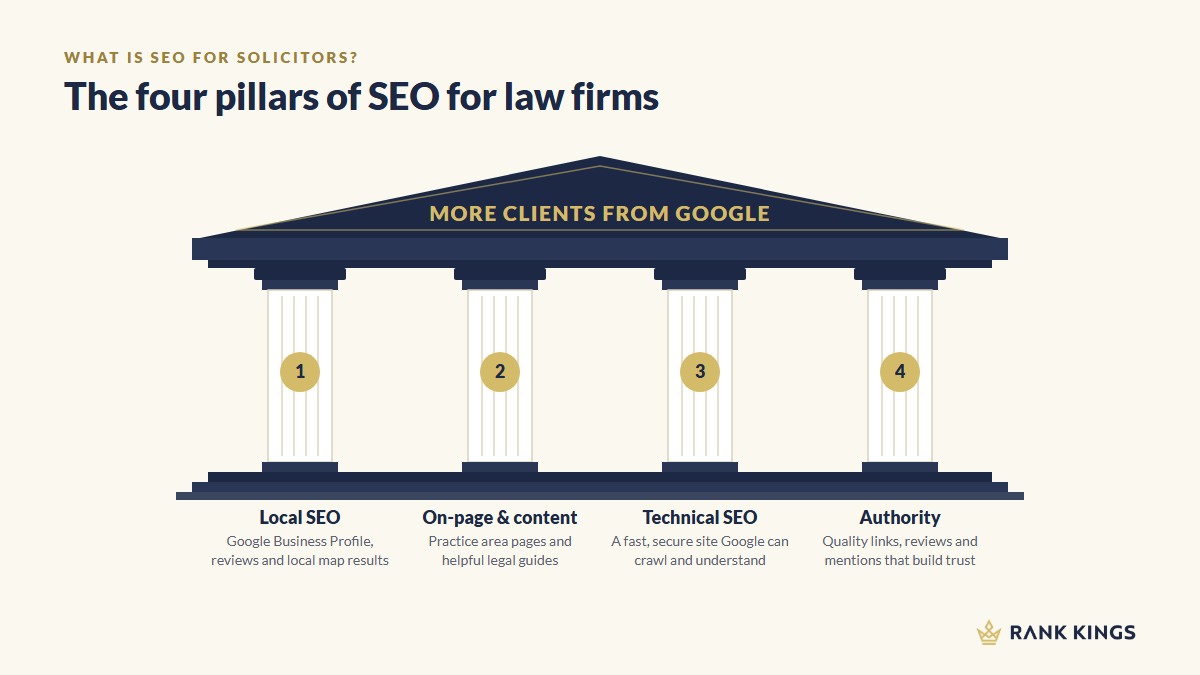
It covers four main areas:
- Local SEO: appearing in the Google local pack (the map results) and local search results when people search for a solicitor in your town or city
- On-page SEO and content: building practice area pages and helpful legal guides that match what clients are searching for
- Technical SEO: making sure your site is fast, secure and easy for search engines to crawl and understand
- Authority: earning links, reviews and mentions that show Google your firm is trustworthy
Good SEO services for solicitors combine all four, so your website content, Google Business Profile and reputation work together rather than in isolation.
Unlike paid ads, you don’t pay for each click. Once your pages rank in the organic search results, they keep bringing in relevant traffic month after month.
Solicitor SEO, law firm SEO and lawyer SEO: what’s the difference?
You’ll see the same discipline called SEO for solicitors, law firm SEO, legal SEO, and, in American content, lawyer SEO or attorney SEO marketing. The principles are the same, but search for “SEO for lawyers” and most of the advice you’ll find is written for the US market. What’s different in the UK is the regulation (the SRA rather than state bars), the directories that matter (such as the Law Society’s Find a Solicitor), and the language clients use. UK clients search for “solicitors” far more than “lawyers” or “attorneys”, so your keywords and content should reflect that.
Why SEO matters for law firms
Legal services are some of the most competitive and valuable searches online. Clicks on Google Ads for practice areas like personal injury or family law can be expensive, and the cost stops bringing results the day you stop paying.
Ranking in organic search gives your firm three big advantages over other forms of law firm marketing.
Lower cost per enquiry over time. Organic traffic doesn’t switch off when a budget runs out. The work you put into a practice area page today can bring in enquiries for years.
Trust and credibility. Many people skip the ads and click the first organic or local pack results, especially when choosing a solicitor for something as important as a divorce, a house purchase or an employment dispute.
Compounding results. Every practice area page, legal guide, review and quality link strengthens the whole website. A strong SEO strategy builds on itself.
SEO and PPC also work well together. Many firms use PPC for law firms to generate enquiries straight away while their SEO builds.
What makes SEO for law firms different
Google holds legal content to a higher standard
Legal advice falls into what Google calls “Your Money or Your Life” (YMYL) topics: content that can significantly affect someone’s finances, safety or wellbeing. For these topics, Google looks hard for signs of experience, expertise, authoritativeness and trustworthiness (E-E-A-T).
For a law firm’s website, that means:
- Content written or reviewed by qualified solicitors, with author names, roles and SRA details
- Clear “About us” and team pages showing qualifications, accreditations and experience
- Accurate, up-to-date information, especially on fees, processes and legislation
- Genuine Google reviews and recognition from trusted legal directories
Regulation shapes what you publish
UK solicitors also need their website to meet Solicitors Regulation Authority requirements. These include the SRA Transparency Rules (publishing price and service information for certain services such as conveyancing, probate and employment tribunal claims) and displaying the SRA digital badge.
These aren’t just compliance boxes. Clear pricing pages answer exactly what many people are searching for, and the badge is a strong trust signal for both clients and Google.
Most legal searches are local
People generally want a solicitor they can meet, or at least one who knows their local courts, property market or council. That makes local SEO the foundation of most law firm SEO strategies.
Local SEO for solicitors
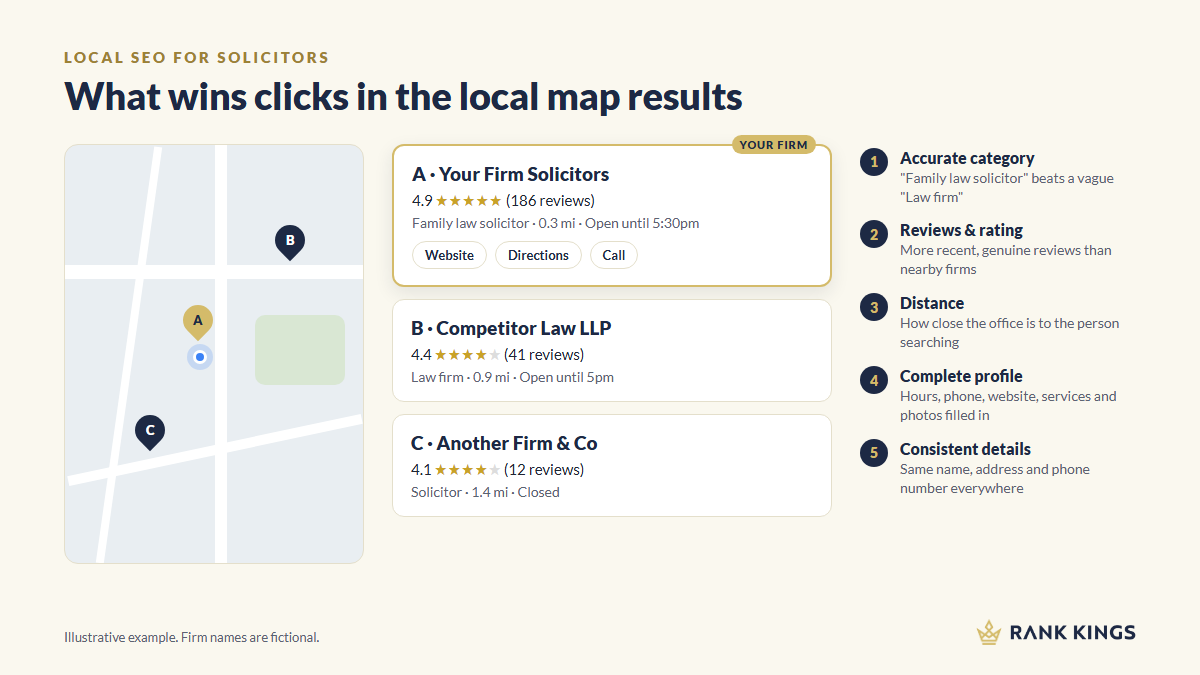
Local SEO is how your firm appears when someone searches “solicitors near me” or “family solicitor in [town]”. For most high street and regional law firms, it’s where the majority of new enquiries come from. Local SEO for law firms starts with your Google Business Profile, and a well-run local SEO campaign builds your local pack visibility from there.
Optimise your Google Business Profile
Your Google Business Profile is often the first thing a potential client sees, in Google Maps and in the local pack at the top of the search engine results page. For each office:
- Use your real firm name, with no keyword stuffing (this breaks Google’s guidelines and risks suspension)
- Choose the most accurate primary category, such as “Law firm” or “Solicitor”, and add relevant secondary categories for your practice areas
- Add every practice area as a service, with a short description
- Upload real photos of your offices and team
- Post updates regularly, such as news, guides and events
- Check your opening hours, phone number and website link are correct
Google Business Profile optimisation is one of the quickest wins in local SEO, and it’s free.
Build Google reviews the right way
Reviews are one of the strongest local ranking factors, and they heavily influence who clients call. Ask satisfied clients for a review once their matter concludes, make it easy with a direct link, and respond professionally to every review, good or bad, without disclosing anything confidential.
Never buy reviews or offer incentives for positive ones. Fake reviews are banned under UK consumer law, and they can damage both your firm’s reputation and your listing.
Alongside Google reviews, legal-specific platforms such as ReviewSolicitors and general platforms like Trustpilot help build trust with prospective clients.
Keep your local listings consistent
Make sure your firm’s name, address and phone number (NAP) match exactly across your website, your Google Business Profile and your local listings. That includes the Law Society’s Find a Solicitor, general directories like Yell, and legal directories such as Chambers and Partners or The Legal 500 if you’re listed.
Inconsistent details confuse search engines and can hold back your local search rankings.
Create genuine location pages
If you have several offices, or serve clients across a wider area, create a dedicated page for each location. Make every page unique: the office address, the solicitors based there, local court or property market knowledge, and reviews from clients in that area.
Avoid copy-and-paste location pages that just swap the town name, because Google tends to ignore them. Our guide to local SEO explains how to build a local SEO strategy that works.
Keyword research for law firms
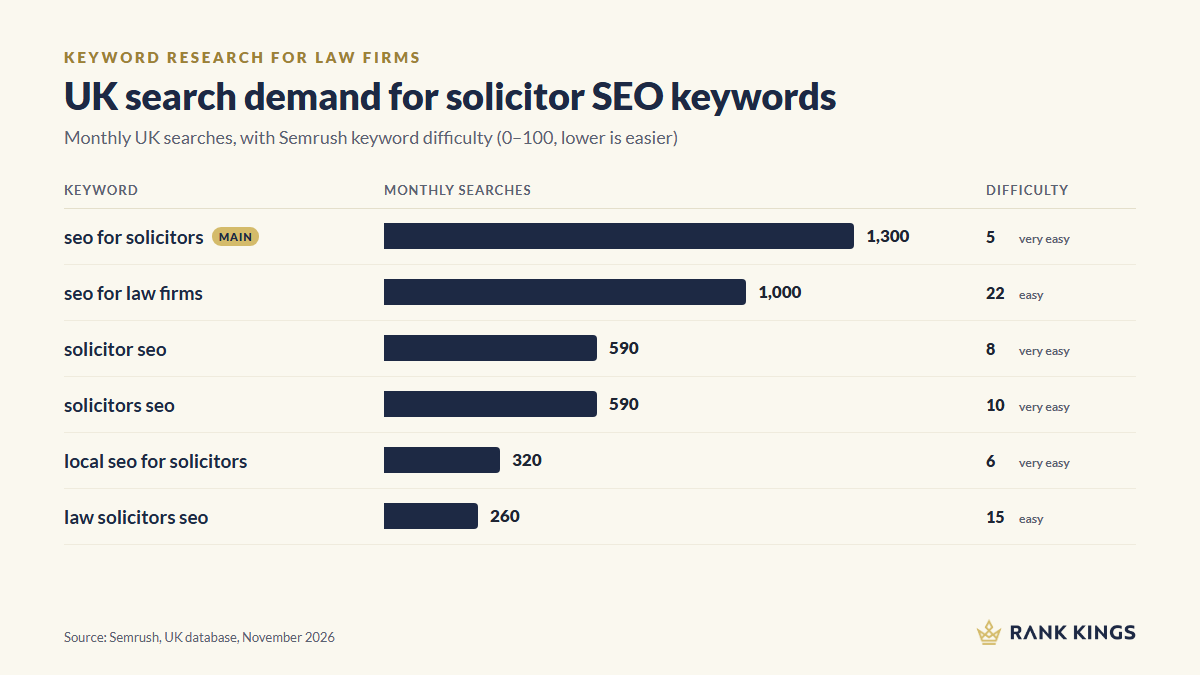
A good SEO campaign starts with understanding exactly how clients search. Keyword research tells you which terms bring relevant traffic, how competitive they are, and what the searcher actually wants.
Understand user intent
Legal searches usually fall into three groups:
| Search type | Example | What the searcher wants |
|---|---|---|
| Service + location | “conveyancing solicitors Stockport” | Ready to instruct a solicitor: target with practice area and location pages |
| Problem-based | “how to get a divorce UK”, “unfair dismissal claim” | Researching their situation: target with guides and FAQs |
| Cost and comparison | “how much does probate cost”, “no win no fee solicitor” | Close to deciding: target with clear pricing and process pages |
Matching each page to the right user intent matters more than squeezing in keywords.
Focus on long-tail keywords
Broad terms like “solicitors” or “personal injury lawyers” are extremely competitive and attract searchers you may not be able to help. Long-tail keywords such as “lasting power of attorney solicitor Stockport” or “contested will solicitor North West” have lower search volumes, but they’re far easier to rank for and much more likely to turn into instructions.
Research your competitors
Look at which firms rank for your target searches and which of their pages perform best. Tools like Semrush and Google Keyword Planner show search volumes, keyword difficulty and the gaps in your competitors’ content.
Choose a primary keyword for every page
Give each important page one primary keyword and a handful of closely related secondary keywords. That keeps each page focused and stops your own pages competing with each other.
On-page SEO: practice area pages that rank
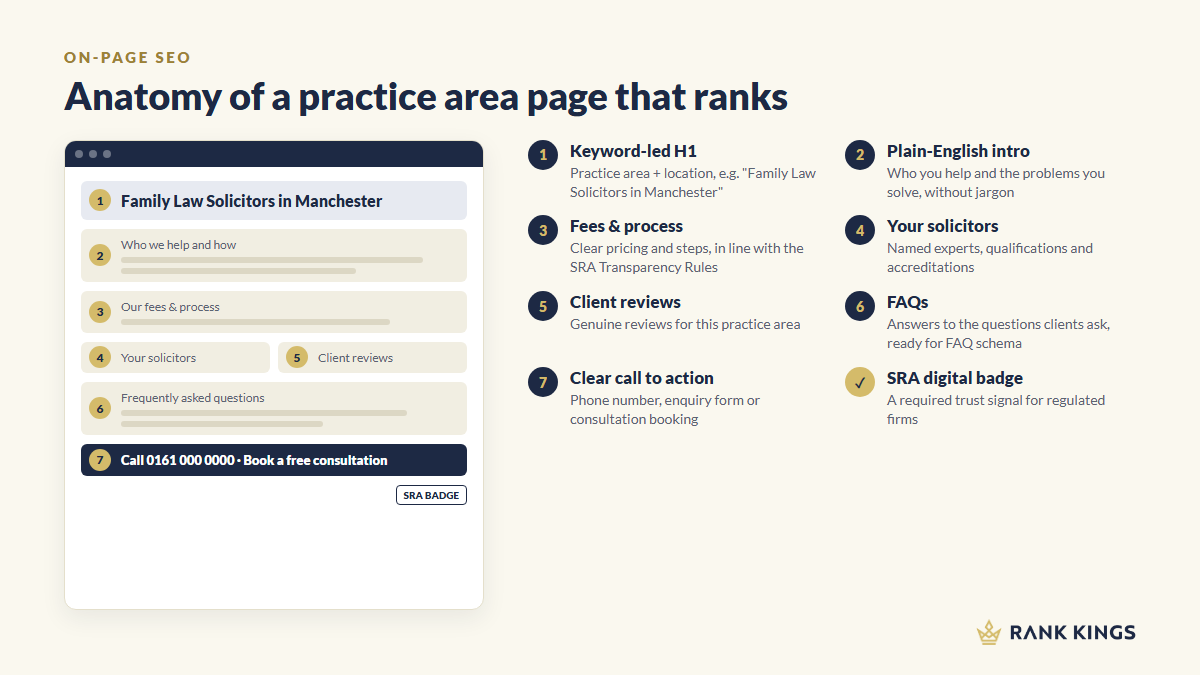
Every practice area you want clients for needs its own dedicated page. Search engines rank individual web pages, not whole websites, so a single “Our services” page listing family law, conveyancing and wills won’t rank for any of them.
What a strong practice area page includes
- One primary keyword, e.g. “family law solicitors in Manchester”, in the title tag, H1 and opening paragraph
- Who you help and how, explained in plain English rather than legal jargon
- Your process and fees, as transparently as the SRA rules and your firm allow
- Proof of expertise: the solicitors who handle these matters, accreditations such as the Law Society Conveyancing Quality Scheme or Resolution membership, and outcomes where you’re able to share them
- An FAQ section that answers common client questions
- A clear call to action: phone number, enquiry form, or booking a free initial consultation if you offer one
Get the on-page basics right
Write title tags and meta descriptions that earn the click, not just include the keyword. Use a logical heading structure, so each section of the page is easy to scan. Add internal links between related pages, for example from a “how divorce works” guide to your divorce solicitors page.
Forget about hitting a “keyword density” target. Write naturally for the reader, cover the topic thoroughly, and the relevant keywords will appear on their own.
Content marketing for solicitors
High quality content is how law firms reach people earlier in their journey and build the authority Google looks for. Of all the digital marketing channels available to solicitors, it’s one of the most effective for firms that want to stand out from local competitors.
Answer the questions clients actually ask
The best topics come straight from questions your team answers every day:
- “How long does probate take in England and Wales?”
- “What happens at a first meeting with a divorce solicitor?”
- “Can I be dismissed without a warning?”
- “What’s the difference between a solicitor and a conveyancer?”
Plain-English guides like these attract people searching for help with a legal problem, and give them a reason to trust your firm.
Show who wrote it
Each guide should be written or reviewed by a qualified solicitor, with their name, role and a short bio. Add the date it was last reviewed, and update it whenever the law changes.
Link content to your services
Link every guide to the relevant practice area page, so readers who need help have a clear next step. Content that doesn’t lead anywhere brings web traffic but very few clients.
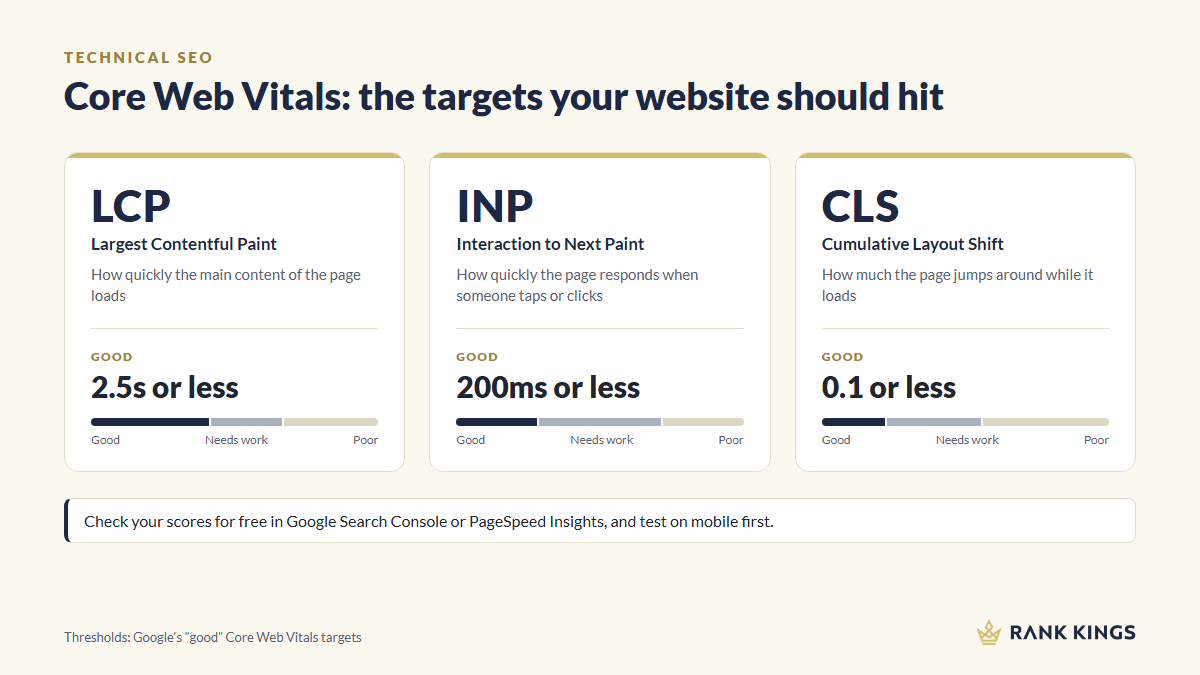
Technical SEO for law firm websites
Even great content won’t rank if search engines struggle with your website. Technical SEO makes sure your site can be crawled, indexed and enjoyed by visitors.
Speed and Core Web Vitals
Most legal searches now happen on mobile, often when someone is stressed and short of time. Your site needs to load quickly and work smoothly on a phone. Google’s Core Web Vitals measure loading speed, responsiveness and visual stability, and they’re worth checking regularly.
Crawling and indexing
Use Google Search Console to check that your important pages are indexed, with no accidental “noindex” tags, blocked pages or crawl errors. It also shows which searches you appear for and where you rank.
Security and site health
Your site should run on HTTPS, with no security warnings. Fix broken links, duplicate pages and redirect chains, which waste Google’s time on your site.
Structured data
Structured data (schema markup) such as LegalService, Organization and FAQPage helps Google understand your firm, your services and your locations. It can also help your listings stand out in the search results on Google, Bing and other search engines.
If you’re not sure where to start, our article on how technical SEO and link building work together explains the basics.
Link building for solicitors
Links from other reputable websites are one of Google’s strongest signals of authority. For law firms, quality matters far more than quantity.
Where good links come from
- Legal directories and professional bodies
- Local sites, such as chambers of commerce, business networks and community sponsorships
- Partner professionals such as accountants, estate agents and financial advisers
- Guest articles for business, property or HR websites where your expertise is genuinely useful
Digital PR for law firms
Digital PR means getting your solicitors quoted in the news. Commenting on a change in the law, a local court decision or a trend in your practice area can earn links and mentions from local news sites and national publications that would be impossible to get any other way.
Whatever you do, avoid buying links or using cheap link-building packages. In a YMYL sector, low-quality links are a real risk to your rankings and your reputation.
SEO for AI search
Clients increasingly ask ChatGPT, Gemini or Google’s AI Overviews questions like “What should I look for in a family solicitor?” These tools draw on the same signals as traditional search: clear, well-structured content, a strong reputation and consistent information across the web.
To give your firm the best chance of appearing in AI answers:
- Answer common questions directly and concisely on your pages
- Keep your firm’s details consistent across your site, Google Business Profile and directories
- Build reviews and mentions on trusted third-party sites
- Use structured data so your services and locations are easy to understand
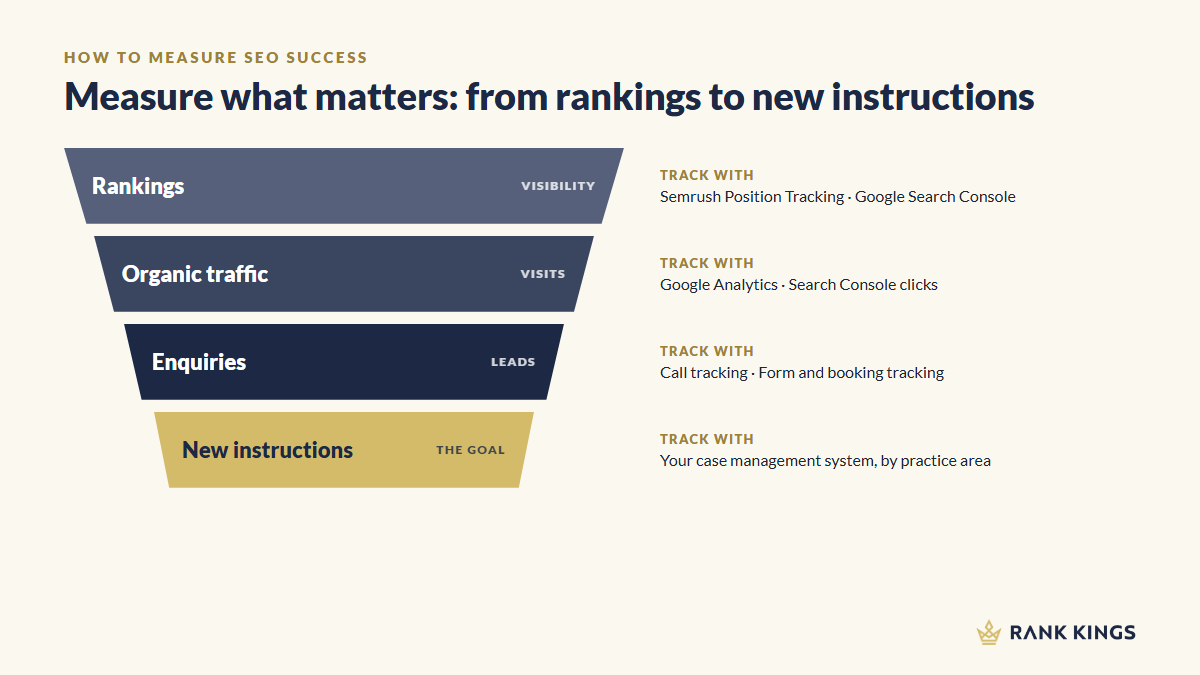
How to measure SEO success
Rankings are useful, but they aren’t the goal. Client acquisition is. Track:
- Enquiries: calls, forms and bookings from organic search, ideally by practice area
- Organic traffic to your practice area and location pages
- Local visibility in the map results for your key searches
- Rankings for your most valuable keywords
Use Google Search Console and Google Analytics alongside call tracking, and review results monthly. That way you know which practice areas are working and where to focus next.
How long does SEO take for solicitors?
Most law firms start to see movement within three to six months, with stronger results building over six to twelve months. It depends on how competitive your practice areas and location are, and on the state of your website when you start.
Local searches in smaller towns can move faster, while national terms like “personal injury solicitors” take sustained work. SEO for law firms also needs continuous attention, because competitors don’t stand still. See how long SEO takes for a fuller explanation.
Common SEO mistakes law firms make
- One generic services page instead of dedicated practice area pages
- Copy-and-paste location pages that Google ignores
- Content with no named author or legal review
- Out-of-date legal information
- Inconsistent firm details across directories
- Ignoring or failing to respond to reviews
- Buying cheap links or SEO packages that promise instant results
- Measuring rankings instead of enquiries and new instructions
Should you do SEO in-house or hire a specialist?
Some firms handle the basics in-house, such as Google Business Profile updates, review requests and blog posts. But technical SEO, keyword strategy and link building take time and specialist knowledge that most solicitors would rather spend on clients.
Plenty of digital marketing companies offer SEO, but few understand the legal sector. If you work with an SEO agency, look for one that understands legal services, explains its work clearly, reports on enquiries rather than just rankings, and doesn’t tie you into a long contract before proving results.
At Rank Kings, we help solicitors and law firms across the UK win more clients through search. Find out more about our SEO for law firms service, or get in touch for a free audit of your firm’s website.
FAQs
What is the best SEO strategy for solicitors?
Start with local SEO (your Google Business Profile, reviews and consistent citations), build a dedicated page for every practice area you want work in, then add helpful content and quality links to grow your authority.
How much does SEO cost for a law firm?
It varies with your practice areas, location and goals. [Rank Kings: add your typical monthly range for law firms.] Be wary of very cheap packages, because poor-quality SEO can harm a regulated firm’s reputation.
Is SEO or PPC better for solicitors?
They do different jobs. PPC brings enquiries immediately but stops when you stop paying. SEO takes longer but builds a lasting stream of clients. Many firms use both.
Do solicitors need a blog?
A blog isn’t essential, but helpful legal guides are one of the best ways to show expertise, rank for question-based searches and build trust with potential clients.
Can a small law firm compete with big firms on Google?
Yes. Local search results favour firms that are close to the searcher, well reviewed and clearly relevant. A small firm with a strong Google Business Profile and focused practice area pages can outrank much larger firms in its own area.


